
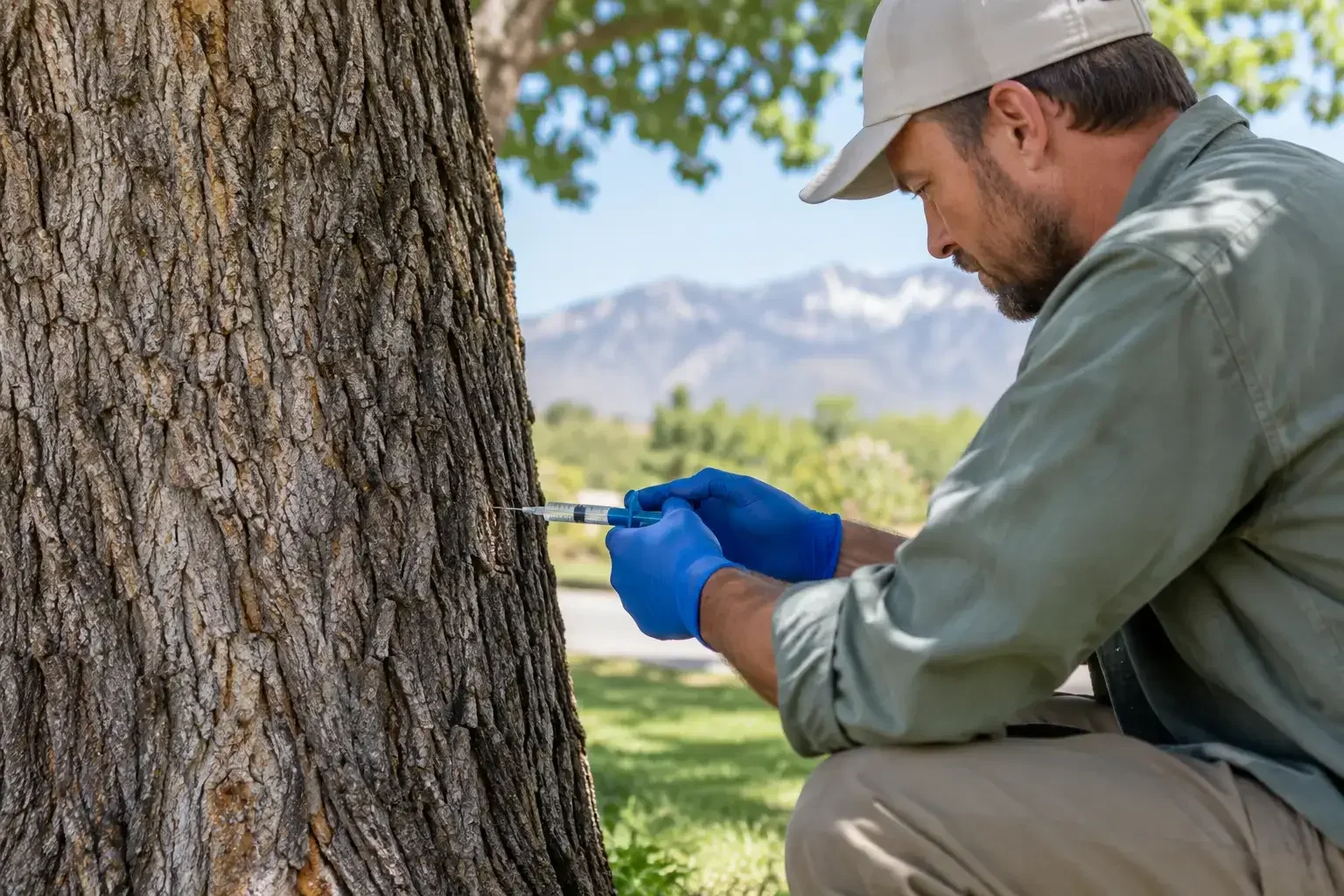
A mature shade tree can take decades to replace. That is why tree injections are often worth a closer look when insects, disease pressure, or nutrient problems threaten a tree you want to keep. They are not a miracle fix, and they are not needed for every yellow leaf or chewed branch. But when the diagnosis and timing are right, injections can protect a valuable tree without broadly spraying the whole yard.
For Utah homeowners and property managers, the practical question is simple: Is this tree facing a problem that an injection can actually solve? The answer depends on the tree species, the pest or deficiency involved, the tree’s current condition, and the time of year.
What tree injections actually do
Tree injections place a measured treatment directly into a tree’s vascular system, usually near the base of the trunk. The tree moves that treatment upward through its internal transport tissues, where it can protect leaves, twigs, branches, or the tree’s crown from certain pests and, in some cases, correct specific nutrient deficiencies.
Think of it as targeted treatment rather than a blanket application. Instead of coating foliage, nearby landscaping, and every surface around the tree, the product is placed where the tree can use it. That can be a smart option around patios, play areas, gardens, pets, and other parts of a busy property.
The treatment used matters. Some injections are designed to manage destructive insects. Others provide nutrients, while certain products may be used as part of a disease-management plan. One injection does not cover every possible tree problem, which is why identifying the issue before treatment matters more than picking the fastest-sounding solution.
When tree injections make sense
Injections are often most useful when the goal is to preserve a healthy or moderately stressed tree that faces a known, treatable threat. Preventive treatment can make sense for high-value trees in an area where a damaging pest is established or expected. Waiting until a tree is heavily damaged is usually the expensive version of the same decision.
Ash trees are a good example. Emerald ash borer has become a serious concern along the Wasatch Front, and it can kill untreated ash trees. Early protection is far more effective than trying to rescue a tree after substantial canopy thinning, bark splitting, or branch dieback has already started. The exact product and treatment schedule depend on the tree’s size, condition, and the recommended timing for that pest.
Tree injections can also be practical where foliar sprays would be inconvenient or less targeted. A tall tree beside a driveway, a playground, or a densely landscaped commercial property may be difficult to spray thoroughly. Injection treatment puts the focus on the tree, not the surrounding space.
Nutrient injections can be useful in narrower situations, especially when a diagnosed deficiency needs faster correction. Still, they are not automatically the best first choice for pale leaves. Utah’s compact, alkaline soils can limit how well some nutrients are available to roots, but yellowing can also come from irrigation problems, root damage, poor drainage, soil compaction, insects, or disease. Treating the wrong cause wastes money and does nothing helpful for the tree.
What injections will not fix
A tree injection cannot repair a cracked trunk, reverse severe root loss, or bring back limbs that are already dead. It also cannot compensate for bad watering habits. A tree that is chronically overwatered, planted too deeply, or deprived of water during a hot Utah summer needs those underlying problems addressed first.
The same goes for advanced decline. If a tree has lost much of its canopy, has major trunk decay, or is structurally unsafe, injection may not be a reasonable investment. A straightforward inspection should include an honest conversation about whether treatment is likely to help, rather than treating a tree simply because treatment is available.
Some pests also live in places where systemic treatment is not the right tool. Surface-feeding insects, webbing pests, and problems confined to a small branch may call for pruning, a targeted exterior application, or a different approach altogether. Good tree care is not about using the same treatment on every problem.
Timing matters more than most people expect
Trees do not move injected materials at the same rate all year. Uptake depends on the species, weather, soil moisture, and whether the tree is actively moving water and nutrients through its system. That is why treatment timing is tied to the pest being managed, not just the day you notice damage.
For some insect threats, a tree needs treatment well before peak feeding begins. For others, treatment is timed around a specific life stage. A professional should follow product-label directions and local pest activity rather than guessing based on a calendar date alone.
Water also plays a role. A severely drought-stressed tree may not take up treatment as effectively as a properly watered one. That does not mean soaking the root zone every day. Deep, appropriate irrigation based on the species, soil, season, and weather gives a tree a better chance to respond well. In Utah, shallow daily watering often creates more problems than it solves.
The trade-offs homeowners should know
Tree injections offer real advantages, but they also involve small wounds at the injection points. When done correctly and only when warranted, trees typically compartmentalize those sites. Repeated unnecessary drilling or poor placement, however, is not good practice. The goal is to use the fewest appropriate injection sites and avoid treating without a clear reason.
Cost is another factor. Treating a mature tree can be less expensive than removal, stump grinding, replacement, and years of waiting for shade to return. On the other hand, not every tree has enough condition or value to justify ongoing protection. A young replacement tree, a declining tree with structural issues, or a species poorly suited to the location may call for a different plan.
There is also an environmental trade-off worth respecting. Targeted injection can reduce drift and broad exposure compared with some spray methods, but it is still a pesticide treatment when insect control products are used. Product selection, application timing, and label compliance matter, especially around pollinator-friendly landscapes. The best treatment is the one that addresses a verified issue with the least unnecessary impact.
A practical way to decide
Start by looking at the pattern of damage. Are leaves thinning across the crown? Are there D-shaped exit holes, peeling bark, dead branch tips, unusual leaf color, or visible insects? Did the problem appear suddenly after construction, a sprinkler change, or extreme heat? These details help separate pest damage from root, soil, or watering issues.
Next, consider the tree’s value. Large shade trees, specimen ornamentals, and established trees that lower summer heat around a home are often worth protecting. A tree that anchors a commercial landscape can be worth even more when you consider curb appeal, tenant experience, and replacement costs.
Then get a clear recommendation before committing. A good provider should explain what they believe is affecting the tree, whether injection is the right method, what result is realistic, and whether the treatment needs to be repeated. “Treat everything just in case” is not a plan. It is a bill.
At Safe Chem Pest, tree protection is approached the same way as pest service: clear recommendations, targeted treatment, and no pressure to buy something you do not need. If your property also needs mosquito, lawn, or recurring pest service, bundling services can lower the total cost without turning tree care into a complicated project.
Protect the tree before it becomes a removal job
A few dead twigs do not always mean disaster, and a yellow leaf is not an automatic reason to inject. But noticeable canopy thinning, repeated insect damage, or trouble in a tree species known to face local pest pressure deserves attention sooner rather than later.
The helpful move is to have the tree evaluated while there is still something substantial to protect. A timely, well-matched treatment can keep a good tree doing what it has always done: giving your property shade, character, and one less thing to worry about.